Categories

Showing posts with label Evidence. Show all posts

Thursday, 26 June 2014

Cyclic Universe: Evidence

Gravity, Flatness and Horizon Problems

This may depend on which model you prefer, but most cyclic models solve the gravity and flatness problems by saying the Big-Bang was powered by the energy from the previous Universe (e.g. Loop-Quantum Cosmology says the Big-Bang was powered by recoil from the previous contracting Universe, and Conformal Cyclic Cosmology says it was powered from left over gravitational radiation). Also, recent models have proposed that the rapid expansion of the current Universe is not fueled by inflation, but by a hypothetical energy called "dark energy".

This also avoids the horizon problem by saying that the Universe expanded beforehand, and then (usually in most models) contracted, leading to the information to come into contact with each other and the similarities to be preserved for the next Big-Bang.

Magnetic-Monopole Problem

Most cyclic models simply avoid this by saying making sure the temperature at the Big-Bang is lower than that needed to create magnetic monopoles. So although magnetic monopoles are possible, they aren't created.

Some cyclic models, such as the Steinhardt-Turok Model, predict a blue-colored gravitational wave spectrum (due to the Universe eventually contracting to a near-singularity), although this hasn't been detected.

Other

In 2010, British mathematical physicist Sir Roger Penrose said in a paper that anomalies in the CMB found by the WMAP satellite were confirmation of a prediction of Conformal Cyclic Cosmology.

Problems

The technique used by Penrose to determine the statistical-significance of his anomalies (whether they were real evidence or just co-incidence) was not based on the standard Lambda-CMB model... but on an undocumented, non-standard approach. So this evidence has been questioned.

The predictions made by cyclic cosmology are largely untestable at this point and therefore it lacks any serious data. Also, if the BICEP2 results are correct, it would mean that the previous predictions of the Paul-Steinhardt Model (that the gravitational waves would be too weak to detect in the CMB) are inconsistent with observation and thus that model would be unlikely.

The main problem though that plagued earlier cyclic models (originally known as "oscillatory" models) was the "entropy" problem.
The 2nd Law of Thermodynamics says that, in a closed system, energy is distributed over time and tends towards disorder (this tendency to go from order to disorder is called "entropy"). For example, heat and energy has spread since the Big-Bang and the Universe has evolved from an ordered, even, low-entropy past to a high-entropy, uneven present filled with galaxies and other structures. Applying this law to the Universe, it was realised there was a problem with the cyclic model, which goes like this:
  1. Entropy can only increase with each cycle.
  2. Logically-speaking, if you go back in time, then the entropy was lower.
  3. If entropy continues to get lower the more you go back, it seems the entropy was originally 0.
  4. It is impossible to have less than 0 entropy.
  5. Therefore, you can't have eternal Big-Bangs and the cyclic model is seriously flawed. 
More recent models have their own approach towards this problem, as we have seen in the previous article Cyclic Universe: Big-Bang ad infinitum.

Acknowledgements

I would, once again, like to thank Hasan Mohammad for co-authoring this article. You can read his own science-related blog here: http://hasansthoughts.blogspot.com.au/

Wednesday, 25 June 2014

Inflation: Evidence

Gravity Problem

One original question with the Big-Bang was why the Universe didn’t immediately collapse back in on itself after the Big-Bang, due to the gravitational attraction. Inflation simply introduced a new type of field, the inflation field (possibly mediated by the “inflaton” particle), which could overcome the attractive force of gravity to expand the Universe. Of course, this field/ particle is purely hypothetical, but there have been some models that try to explain it.

Flatness Problem 

Cosmologists used to wonder why the Universe seems so (space-time wise) flat, as General Relativity and the Big-Bang Theory expects it to be curved. Inflation solves this by saying that the Universe has simply expanded so rapidly that any curvature becomes negligible, and it seems just flat (kind of like how the Earth only looks flat to us, but is really round).


WMAP sattelite data has confirmed the Universe is mostly-flat with only a 0.4% margin for error.

Horizon Problem

Why is the distribution of galaxies, stars and other structures in the Universe so evenly-spread, when Special Relativity forbids it? Let me give you an example. From Earth, the furthest extent to which we could possibly see out into space is 46.5 billion light years (this is called our cosmological horizon). Due to space-time being curved on the largest scales, there is simply no way we can see past that distance (kind of like how on Earth, no matter how good your eyesight, you just can’t see over the horizon).So that means, from end to end, the total length of our scope is 93 billion light-years apart. Keep in mind that this isn’t even the whole Universe; simply the distance to which we could see.
However, as the Big-bang was 13.72 billion years ago, there’s no way information (e.g. energy, matter) could travel fast enough from one end of the scope to another to have created the galaxies and structures we see today.  Even travelling at the speed of light, 13.72 billion years just isn’t enough time for the information to have travelled from one end to another. It’s like if I lit a fire in a stadium. I could expect there to be some smoke in the air around the fire, but that smoke won’t have spread to the whole stadium instantly. Maybe it could after a while, but the smoke only has a limited amount of time. In this case, the galaxies are the smoke and the Universe is the stadium. So why do we see such evenly-spread and similar galaxies across the Universe?
Inflation solves this by saying the Universe was originally much smaller before the Big-Bang then initially thought. All the information had time to interact with each other and preserve the similarities before the Big-Bang, so that the uniformity remained after the Big-Bang (like if I lit a fire in a deflated balloon, and then inflated it. The smoke would have time to spread out).

Magnetic-Monopole Problem 

This one is more based in theoretical physics, but is still worth mentioning. Extremely high-energy physics says there should be an abundance of strange, heavy, stable particles called “cosmic defects”. These are twisted “knots” of energy that should have formed in the high temperatures of the early Universe. One example of such a defect would be a magnetic monopole (a magnetic field with only 1 pole, unlike the traditional North-South pole).The main issue is why we haven’t discovered any yet, as they are supposed to survive the transition from high-energy to low-energy. Inflation basically clears this up by saying that the inflationary period separated them by so great a distance that their observed density decreased so that it would be nearly-impossible to find them.

BICEP2 Results

This potential discovery is one of the main reasons inflation is the most popular hypothesis (however, the data has recently come under scrutiny from other independant groups).

The most convincing evidence found for inflation so far is the ripples in space-time observed in the CMB on the 14th of March, 2014, by the BICEP2 satellite. These ripples imply they were created by gravitational waves in the earliest moments after the Big-Bang, a prediction made by inflation. It’s the first direct evidence for inflation (possibly).

Observations

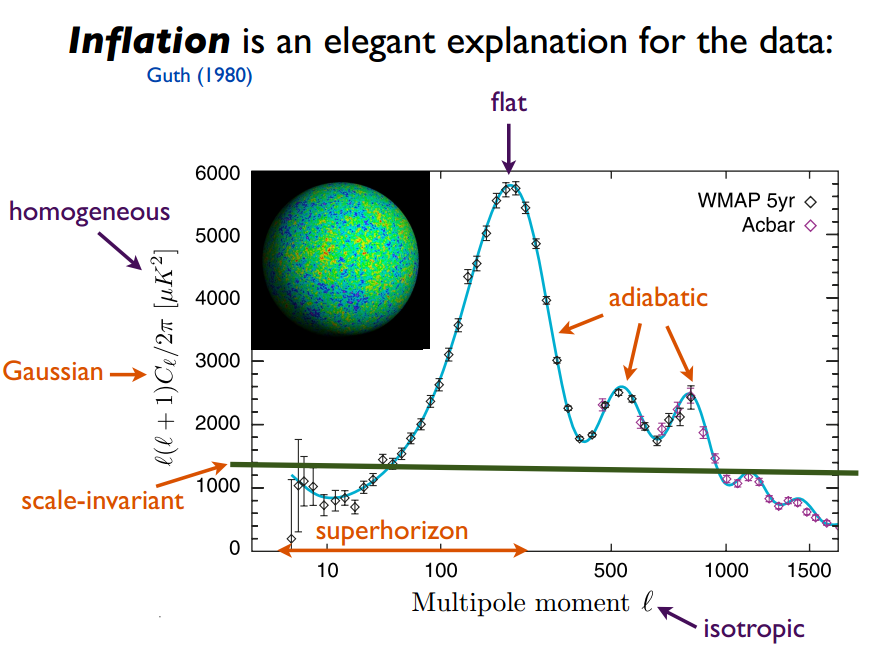
However, even before BICEP2, inflation was still the most popular hypothesis to explain the Big-Bang as its explanations and predictions matched so well with the observational data. 


A graph of the precise temperature differences in the CMB on the vertical-axis and the rotation speed on the horizontal-axis. The blue line's inflation's predictions, which seem to match up well with the WMAP and ACBAR sattellite data.

Problems

Of course, inflation has some of its own issues. Mainly, that inflation has been criticized as “artificial” as most of its models (with the exception of chaotic inflation) require very specific conditions to operate under. Furthermore, the inflation field (or “inflaton” particle) thought to have caused inflation is completely hypothetical, and doesn't match any field or particle known to science (yet).

So now we've covered the basics of how inflation works and why it is, currently, the most-accepted hypothesis to explain the Big-Bang. In the next article we'll look at the Cyclic-Universe hypothesis, an adjunct to inflation.

Acknowledgements

I would, once again, like to thank Hasan Mohammad for co-authoring this article. You can read his own science-related blog here: http://hasansthoughts.blogspot.com.au/