Categories

Showing posts with label Articles. Show all posts

Monday, 11 August 2014

Abiogenesis: Recipe of Life

The question of the origin of life is one of the last, great frontiers humankind has yet to answer. We know that life must have started out as simple organisms such as prokaryotes (single celled organisms) and then develop from there into more complex eukaryotes (multi- cellular organisms) eventually giving rise to the variety of species we see today, but this doesn't tell us much about the origin of life itself. Well, modern science, whilst not having a definitive answer, may have an idea of how that life came into being.

First of all, one should determine what classifies as life. Although there is no "standard" model of abiogenesis, multiple hypotheses have shown that life-like processes (such as replication, ingestion of nutrients, evolution and metabolism) could have been displayed/arose through certain chemical reactions. So such processes are as good a place to start as any.

Models

RNA-World Hypothesis

Most people recognize today that the most empirical definition of life is the presence of DNA (deoxyribo-nucleic acid). After all, it encodes our genetic information and contains the essential blue prints of life. But how did DNA come about in the first place? This hypothesis says that the first life would have been RNA (ribo-nucleic acid), which would have served as the basis for DNA. This is because certain proteins are needed to replicate DNA.However, it is DNA that has the genetic information needed to create these proteins. So it becomes a puzzling question of which came first; proteins or DNA?
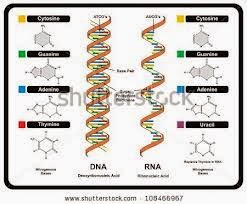
One strand of RNA and one strand of DNA are so similar that they can combine to form a new DNA molecule.
It's thought that RNA would have served the purpose of storing genetic information, before being replaced by DNA. This is because RNA would have been needed to act as a catalyst (speed up the chemical reactions) to create amino-acid polymers (the proteins). These proteins would have then created DNA. DNA would have then replaced RNA as a storer of genetic information as DNA was more stable, and polymers/proteins would have replaced RNA as a catalyst as they were more varied and suitable for suitable jobs.

Most scientists do believe that modern life was descended from an RNA world, but there is still debate as to whether or not RNA-based life was the first type of life to originate.

Deep, Hot Biosphere Hypothesis

This hypothesis states that the earliest life foms didn't form on land, or even at the bottom of the ocean. Raher, they fromed several kilometres underground. It is pretty similar to the iron-sulphor theory in that it predicts life arose from similar chemical reactions (which we'll get to in a second). However, it is still worth mentioning as an underground environment would, ideally, shelter the microbial life from the turmoil of the surface, such as asteroids and radiation.

It's believed that whatever organisms formed would have to get their nutrition from a continuous trickle of chemicals from deep within the Earth. However, this energy source would also have to be unreachable. For if it was  too easily accessible, it would lead to unsustainable-consumption and the life would eventually be left with no source of nutrition. Possible candidates for this food source could include hydrogen (released from interactions between water and iron compounds), methane in the Earth's mantle and carbon compounds.


Interesting: A controversial prediction of this hypothesis is that oil would be produced as a byproduct of the underground microbes consuming methane. This would imply that oil does NOT come from the surface remains of animals being compressed, as is currently believed, but is actually being continually produced.

Iron-Sulfur Hypothesis

This hypothesis states that life started out on the surface of iron sulfide minerals. This states that the earliest life didn't rely on DNA or RNA for propagation, but rather relied on chemicals from hydrothermal vents on the ocean floor.

Hydrothermal vents are important to a group of life known as "chemoautotrophs", which convert inorganic chemicals from hydrothermal vents into organic chemicals (through oxidation reactions) for nutrition. It's thought that perhaps a similar process such as this led to the first replicating chemicals with metabolism-like chemical cycles, which would gradually increase in complexity with more chemicals (a chemical evolution that would later give rise to a biological evolution).
Water + Carbon Dioxide + Hyfrogen Sulphide =
Sugar + Sulphur Compounds
It's thought that since hydrothermal vents can convert inorganic chemicals into organic chemicals and provide both the chemical nutrition and heat required for life to survive, that the earliest life forms would have lived near hydrothermal vents. This hypothesis fits into the unique "metabolism-first, genetics-later" category of models.

Clay Hypothesis

A peculiar model, this one states that the original chemicals responsible for information replication would have been silicate crystals. This is as they imitate similar phenomena as living organisms. For example, stickier clays tend to stick to river beds, and the stickier the riverbed, the more likely it is to attract more sticky clays. Therefore, through simple chemistry, clays of the stickier variety are more likely to last by being attracted to other sticky clays through a simple, chemical selection process. A type of "natural selection", if you will.
The process of natural selection is also mirrored through clays by the fact that specific clay crystals will attract certain molecules that will make it grow further.

It's thought that these specific crystals could have then acted as catalysts to eventually create primitive organic molecules, thus paving the way for RNA and DNA.

Other Models

These models, whilst being plausible, are either too complex or too similar to the ones already mentioned above, and thus wold be largely uninteresting to describe in this limited amount of space. They are the:
  • Zn-World Hypothesis
  • PAH-World Hypothesis
  • Lipid-World Hypothesis
  • Radioactive Beach Hypothesis
Interesting: Perhaps the strangest hypotheses, panspermia supposes that primitive cells could have originated outside of Earth, and then come to our planet via meteorite/s, meaning that all life on Earth is descended from (basically) aliens! Although it has its own unique evidence and discussion surrounding it, it technically does not answer the question of life's origins. It merely pushes it away, and thus will not be discussed in too great detail here.

Well, that concludes this brief introduction to the field of abiogenesis, a field of ongoing research. In the next article, we'll look at the respective pieces of evidence and difficulties with some of these models.

Thursday, 26 June 2014

Cyclic Universe: Evidence

Gravity, Flatness and Horizon Problems

This may depend on which model you prefer, but most cyclic models solve the gravity and flatness problems by saying the Big-Bang was powered by the energy from the previous Universe (e.g. Loop-Quantum Cosmology says the Big-Bang was powered by recoil from the previous contracting Universe, and Conformal Cyclic Cosmology says it was powered from left over gravitational radiation). Also, recent models have proposed that the rapid expansion of the current Universe is not fueled by inflation, but by a hypothetical energy called "dark energy".

This also avoids the horizon problem by saying that the Universe expanded beforehand, and then (usually in most models) contracted, leading to the information to come into contact with each other and the similarities to be preserved for the next Big-Bang.

Magnetic-Monopole Problem

Most cyclic models simply avoid this by saying making sure the temperature at the Big-Bang is lower than that needed to create magnetic monopoles. So although magnetic monopoles are possible, they aren't created.

Some cyclic models, such as the Steinhardt-Turok Model, predict a blue-colored gravitational wave spectrum (due to the Universe eventually contracting to a near-singularity), although this hasn't been detected.

Other

In 2010, British mathematical physicist Sir Roger Penrose said in a paper that anomalies in the CMB found by the WMAP satellite were confirmation of a prediction of Conformal Cyclic Cosmology.

Problems

The technique used by Penrose to determine the statistical-significance of his anomalies (whether they were real evidence or just co-incidence) was not based on the standard Lambda-CMB model... but on an undocumented, non-standard approach. So this evidence has been questioned.

The predictions made by cyclic cosmology are largely untestable at this point and therefore it lacks any serious data. Also, if the BICEP2 results are correct, it would mean that the previous predictions of the Paul-Steinhardt Model (that the gravitational waves would be too weak to detect in the CMB) are inconsistent with observation and thus that model would be unlikely.

The main problem though that plagued earlier cyclic models (originally known as "oscillatory" models) was the "entropy" problem.
The 2nd Law of Thermodynamics says that, in a closed system, energy is distributed over time and tends towards disorder (this tendency to go from order to disorder is called "entropy"). For example, heat and energy has spread since the Big-Bang and the Universe has evolved from an ordered, even, low-entropy past to a high-entropy, uneven present filled with galaxies and other structures. Applying this law to the Universe, it was realised there was a problem with the cyclic model, which goes like this:
  1. Entropy can only increase with each cycle.
  2. Logically-speaking, if you go back in time, then the entropy was lower.
  3. If entropy continues to get lower the more you go back, it seems the entropy was originally 0.
  4. It is impossible to have less than 0 entropy.
  5. Therefore, you can't have eternal Big-Bangs and the cyclic model is seriously flawed. 
More recent models have their own approach towards this problem, as we have seen in the previous article Cyclic Universe: Big-Bang ad infinitum.

Acknowledgements

I would, once again, like to thank Hasan Mohammad for co-authoring this article. You can read his own science-related blog here: http://hasansthoughts.blogspot.com.au/

Cyclic Universe: Big-Bang ad infinitum

In the last article (Inflation: Evidence), we looked at the most-commonly supported hypothesis to explain the Big-Bang and how it shaped the modern Universe. In this article we'll be looking at cyclic cosmology. An adjunct to inflation, this model proposes that, rather than expanding faster than light soon after the Big-Bang… the Big-Bang was actually preceded by another Big-Bang. When a universe ends, it’s followed by another Big-Bang, and so on for infinity (hence the term "cycle"). So the Universe is, in a sense, eternal. Although originally formed as an alternative to inflation, some cyclic models actually combine this idea of a cyclic Universe with inflation.

Models

Some examples of the different mathematical variants of the cyclic universe hypothesis includes:

Baum-Frampton Model

This model says that the Universe will continue to expand at an accelerating rate. But less than a thousand-trillion-trillionth (10 to the negative 27th power) of a second before the would-be Big-Rip (tearing of the fabric of space-time), the Universe starts contracting. After contracting to a point, it will undergo another Big-Bang (or, technically, a Big-Bounce in this case), powered by inflation, which will split our current Universe apart into many small Universes, each ready to start expanding again.

It solves the entropy problem (see Cyclic Cosmology: Evidence) as the near-maximum entropy is divided between the many Universes, so our individual Universe therefore has low entropy. As each Universe contracts, there's no matter or other energy in it except for dark energy, so there is almost no entropy. During inflation, entropy is gradually restored (from the theoretical inflaton field becoming excited and disordered). 

Many cyclic models predict a "Big Bounce", where the Universe contracts to a point then "bounces" back.
However, the likelihood of the model has been called into question, as the Hubble length (13.72 billion light-years) in the model becomes infinite by the time the Universe finishes expanding and begins contracting. 

Aguirre-Gratton Model

A unique model, this one says that inflation will not only continue infinitely into the future, but continued infinitely into the past as well. So it’s a special type of model that believes the Big-Bang began with an infinitely contracting Universe till it got to a point 13.72 billion years ago, at which point it began expanding.

A diagram of de Sitter space-time (vacuum solution of how space is structured, according to General Relativity). To summarize, if one assumes this space to be divided into 2 regions that can't interact with each other... inflation can extend infinitely into the past.
Entropy increases as energy is distributed. And since the Aguirre-Gratton Model says that the Universe was contracting until 13.72 billion years ago, the energy was coming into contact with each other, rather than being distributed. So this model manages to get around the entropy problem by saying that we originally went from a state of high energy to low energy, and now we're going towards high energy again.

Whilst this model is mathematically-possible, the authors themselves admit it is very based on General Relativity, and does not really take into account quantum effects.

Conformal Cyclic Cosmology

This hypothesis says that the Universe will continue to expand exponentially and the heat will dissipate until it becomes too cold for matter to exist. The matter will convert into light (E=mc squared), and with no matter there is no measure of time (the scientific definition of time isn't exactly like our common understanding of time). With no measure of time, there’s nothing to differentiate the future from the past. Thus, another Big-Bang occurs, ad infinitum.

It solves the entropy problem by saying that a certain amount of gravitational radiation carries over from the death of one Universe to the birth of another, but is not distributed-evenly immediately, providing a low amount of entropy every cycle.

Loop Quantum Cosmology

Based on the theoretical field of loop quantum gravity, which assumes that space-time is made up of fundamental units on the smallest scales (kind of like how matter is made up of atoms on the smallest scales), this hypothesis tries to solve the problem of the singularity by saying that the Universe can’t be constrained to a single point. Rather, after expanding for a time then contracting, it will stop at the Planck length (the smallest length physically-possible).


This is because loop quantum gravity predicts (based on quantum geometry) a new repulsive force. At large sizes, this force’s effects are negligible. However, at Planck length, it is magnified to such levels that it overcomes the gravitational strength of the singularity and repels the Universe, forming a “quantum bounce” between Universal end and rebirth. However, it also predicts an inflationary period. So it’s both cyclic and inflationary.

Loop quantum cosmology gets around the entropy problem by taking into account "horizon" entropy. We mentioned in the last article that a cosmological horizon is the furthest distance at which you can receive information (or to put simply, to which we could possibly see). Horizons have their own measure of entropy, which's proportional to their size.

The equations of loop quantum cosmology say that near the bounce, the horizon engulfs the Universe, and the entropy increases to great heights. However, the horizon disappears after the bounce, thereby eliminating the entropy. So, in a sense, the entropy is reset at the Big Bounce, so it never goes below 0.

Other Models

These models, whilst being plausible, are largely-based in mathematics and are difficult and/or uninteresting to describe in simple words. They are:

  • Carroll-Chen Model
  • Steinhardt-Turok (Ekpyrotic) Model
Interesting: A 3rd less-popular hypothesis to explain the Big-Bang other than inflationary and cyclic cosmology exists, called the “varying speed of light” hypothesis. It says the speed of light was faster in the past than it is now, thus solving the horizon problem by saying that information came into contact in the past. However, as this doesn't solve any of the other problems in cosmology (and seems to go against relativity), it is not part of mainstream physics.

Acknowledgements

I would, once again, like to thank Hasan Mohammad for co-authoring this article. You can read his own science-related blog here: http://hasansthoughts.blogspot.com.au/

Wednesday, 25 June 2014

Inflation: Evidence

Gravity Problem

One original question with the Big-Bang was why the Universe didn’t immediately collapse back in on itself after the Big-Bang, due to the gravitational attraction. Inflation simply introduced a new type of field, the inflation field (possibly mediated by the “inflaton” particle), which could overcome the attractive force of gravity to expand the Universe. Of course, this field/ particle is purely hypothetical, but there have been some models that try to explain it.

Flatness Problem 

Cosmologists used to wonder why the Universe seems so (space-time wise) flat, as General Relativity and the Big-Bang Theory expects it to be curved. Inflation solves this by saying that the Universe has simply expanded so rapidly that any curvature becomes negligible, and it seems just flat (kind of like how the Earth only looks flat to us, but is really round).


WMAP sattelite data has confirmed the Universe is mostly-flat with only a 0.4% margin for error.

Horizon Problem

Why is the distribution of galaxies, stars and other structures in the Universe so evenly-spread, when Special Relativity forbids it? Let me give you an example. From Earth, the furthest extent to which we could possibly see out into space is 46.5 billion light years (this is called our cosmological horizon). Due to space-time being curved on the largest scales, there is simply no way we can see past that distance (kind of like how on Earth, no matter how good your eyesight, you just can’t see over the horizon).So that means, from end to end, the total length of our scope is 93 billion light-years apart. Keep in mind that this isn’t even the whole Universe; simply the distance to which we could see.
However, as the Big-bang was 13.72 billion years ago, there’s no way information (e.g. energy, matter) could travel fast enough from one end of the scope to another to have created the galaxies and structures we see today.  Even travelling at the speed of light, 13.72 billion years just isn’t enough time for the information to have travelled from one end to another. It’s like if I lit a fire in a stadium. I could expect there to be some smoke in the air around the fire, but that smoke won’t have spread to the whole stadium instantly. Maybe it could after a while, but the smoke only has a limited amount of time. In this case, the galaxies are the smoke and the Universe is the stadium. So why do we see such evenly-spread and similar galaxies across the Universe?
Inflation solves this by saying the Universe was originally much smaller before the Big-Bang then initially thought. All the information had time to interact with each other and preserve the similarities before the Big-Bang, so that the uniformity remained after the Big-Bang (like if I lit a fire in a deflated balloon, and then inflated it. The smoke would have time to spread out).

Magnetic-Monopole Problem 

This one is more based in theoretical physics, but is still worth mentioning. Extremely high-energy physics says there should be an abundance of strange, heavy, stable particles called “cosmic defects”. These are twisted “knots” of energy that should have formed in the high temperatures of the early Universe. One example of such a defect would be a magnetic monopole (a magnetic field with only 1 pole, unlike the traditional North-South pole).The main issue is why we haven’t discovered any yet, as they are supposed to survive the transition from high-energy to low-energy. Inflation basically clears this up by saying that the inflationary period separated them by so great a distance that their observed density decreased so that it would be nearly-impossible to find them.

BICEP2 Results

This potential discovery is one of the main reasons inflation is the most popular hypothesis (however, the data has recently come under scrutiny from other independant groups).

The most convincing evidence found for inflation so far is the ripples in space-time observed in the CMB on the 14th of March, 2014, by the BICEP2 satellite. These ripples imply they were created by gravitational waves in the earliest moments after the Big-Bang, a prediction made by inflation. It’s the first direct evidence for inflation (possibly).

Observations

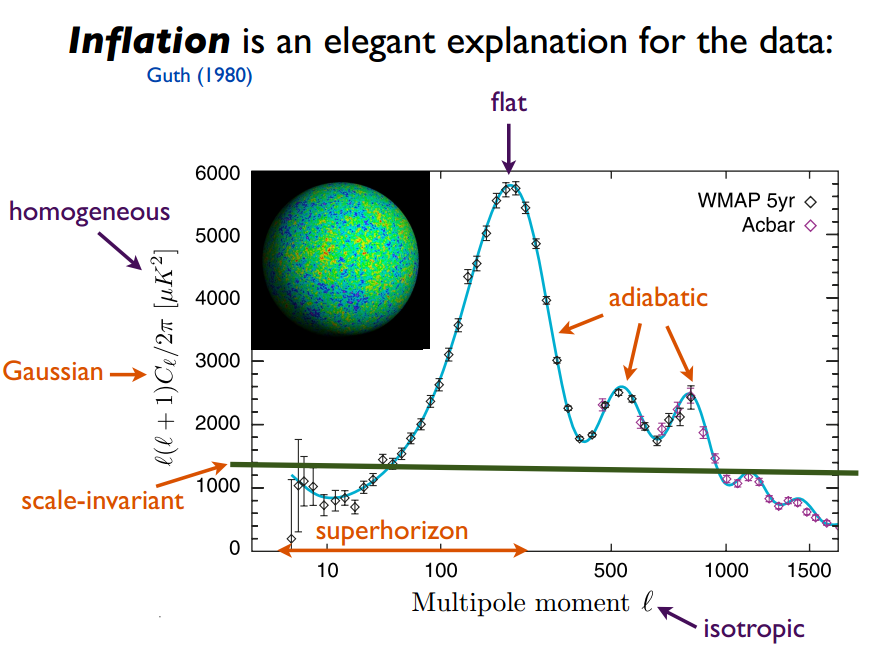
However, even before BICEP2, inflation was still the most popular hypothesis to explain the Big-Bang as its explanations and predictions matched so well with the observational data. 


A graph of the precise temperature differences in the CMB on the vertical-axis and the rotation speed on the horizontal-axis. The blue line's inflation's predictions, which seem to match up well with the WMAP and ACBAR sattellite data.

Problems

Of course, inflation has some of its own issues. Mainly, that inflation has been criticized as “artificial” as most of its models (with the exception of chaotic inflation) require very specific conditions to operate under. Furthermore, the inflation field (or “inflaton” particle) thought to have caused inflation is completely hypothetical, and doesn't match any field or particle known to science (yet).

So now we've covered the basics of how inflation works and why it is, currently, the most-accepted hypothesis to explain the Big-Bang. In the next article we'll look at the Cyclic-Universe hypothesis, an adjunct to inflation.

Acknowledgements

I would, once again, like to thank Hasan Mohammad for co-authoring this article. You can read his own science-related blog here: http://hasansthoughts.blogspot.com.au/

Saturday, 21 June 2014

Inflation: Hyper Big-Bang

This hypothesis says, basically, that the Universe expanded much faster after the Big-Bang then we had previously thought. In fact, it says it expanded faster than the speed of light (10 to the 26th power) one hundred- million- billion- billion- billionths of a second after the Big-Bang (we talked about how this is possible in our last article, Big-Bang: Cosmic Evolution), before slowing down to a lower speed, then continually accelerating.

Models

Some examples of the different mathematical variants of inflation include:

Eternal Chaotic Inflation

Most inflationary models predict that when the Universe inflated, it would slow down, to an extent, and then speed up again. However, what makes this particular version unique is that it predicts that inflation never slows down in some areas of the Universe, which continue to expand faster than light. As they expand faster than the speed at which information from the rest of the Universe can reach them, they are isolated and, for all practical purposes, independent Universes.


Most inflationary models predict the number of Universes to grow to infinity, giving rise to a "multiverse".
This is the most popular model as it doesn’t require specific conditions such as an initial high- temperature (which plagued earlier models of inflation), and it can provide a (relatively) realistic explanation for life. Different universes may have different low-energy laws of physics, and therefore only some have the right laws to allow life to exist (such as our own).

Higgs Inflation

This hypothesis states that the mysterious and unheard of “inflaton” particle or field was, in fact, the higgs field. It is technically possible, as the higgs particle has a quantum spin of 0, and the inflaton is theorized to have a quantum spin of 0 as well.
However, it only works if one considers there to be other unknown fields interacting with the Higgs field to be able to overcome the gravitational force (a process known as “minimal coupling”). Whilst minimal coupling is a possible phenomenon, it involves creating hypothetical fields beyond the Standard Model of Physics, which obviously involves making a lot of hypothetical assumptions. Furthermore, if the BICEP2 data truly is correct, it would mean that the Higgs-Inflation (at least in its current form) is too weak to be a real candidate for inflation.


Could the Higgs-Boson particle be the elusive inflaton?

Supergravity Inflation

This hypothesis (like many others) tries to reconcile quantum physics and general relativity by saying that gravity is mediated by a particle called the “graviton”, which has a super-partner particle called the “gravitino”. Super-gravity inflation (unlike super-symmetry inflation) says that super-symmetry is local (only occurs in specific areas), which make it more flexible. The introduction of a super-partner to the graviton also removes some mathematical quirks (such as infinite values). The fact that some versions are expected to produce a 4-dimensional Universe like this on and are possible explanations of M-Theory (the most widely-accepted model of String-Theory, which says all particles are 1 dimensional vibrating strings) is what makes super-gravity inflation, and super-gravity in general, a possible candidate for inflation.
However, it does have its problems. Most super-gravity models predict an expansion rate of the Universe far greater than is currently-observed. Furthermore, many other predictions made by super-gravity inflation are untestable as of yet.

Other Models

These models, whilst being plausible, are largely based in mathematics and are difficult and/or uninteresting to describe in simple words. They are:
·         Natural inflation
·         Hilltop Quartic model
·         Power law inflation
·         R-squared inflation
·         Axion-Monodromy inflation
·         Low-Scale Spontaneous-Symmetry-Breaking Super-Symmetric inflation
Interesting: Some models can actually overlap, with there being examples of chaotic natural inflation and natural inflation based on super-gravity.
So there are the basics of inflation and the different models of it. In the next article we’ll look at the evidence for inflation.

Sunday, 15 June 2014

Big-Bang: Cosmic Evolution

As we've discussed in a previous article Quantum Cosmology: Birth of a Universe, the Big-Bang was not the ACTUAL beginning of the Universe, but rather described its exponential development since its creation (if it was indeed created). But in this article, I plan to talk more about what the Big-Bang actually was and clear up any misconceptions about it.
First of all, the Big-Bang was not an actual “Bang”, or explosion (that’s actually quite a misleading name). Rather, it was actually an expansion of space-time.
Interesting: The name “Big-Bang” was actually first coined by a critic of the Big-Bang, astronomer Fred Hoyle. Although he used it in a mocking sense, the name was so memorable it stuck!
Another misconception (or rather misunderstanding) you may have learnt about the Big-Bang from high-school is that it started out from a “singularity”; a point with infinite density and 0 volume. It is important not to take this definition literally though, as it’s actually physically-impossible for such an object to exist. General Relativity says no point can have infinite density or energy. And if you've read the previous article, you might remember that the currently most-accepted hypothesis by cosmologists is that the Universe started out as a virtual particle, and quantum physics doesn’t allow a particle to inhabit a space smaller than its wavelength (i.e. 0 volume).
Singularities are a sign that current general relativity and quantum mechanics aren't suitable to adequately explain points of high gravity. Developing a quantum theory of gravity to solve the problem of this mathematical quirk has become the goal of modern cosmology.
One of the main pieces of evidence and main sources of information about the Big-Bang is the fact that galaxies are travelling away from us, a prediction of the Big-Bang Theory. With the Hubble space-telescope, we were able to first see that the light from distant galaxies was red-shifted (this meant that their wavelengths were being stretched out by movement away from us), which provided the first real evidence of the Big-Bang Theory. In fact, this was the case with all the galaxies we saw around us.

Waves are stretched out in the direction the object emitting them is moving away from and is cramped in the direction the object is moving towards, according to the Doppler Effect.
Interesting: Although similar, the cosmological red shift is not EXACTLY the Doppler Effect, as the waves don’t travel through a medium (space is a vacuum). Rather, it is the expanding space between galaxies that causes the light to stretch out and become red-shifted.
Now, that does seem to have interesting implications. If all the galaxies we saw were moving away from Earth, wouldn't that mean that the Milky Way (our galaxy) is the centre of the Universe? Not exactly. See, from our point of view, it may look like we’re the centre. But imagine (for example) how an alien would view us from another galaxy. As the distance between our galaxies grows, they would also think they are the centre! So unless you can think about the Universe objectively from the outside, than any (and every) point in space can look like the centre.

Depending on how you think about it, you can therefore say that the Universe has either no centre... or eveywhere is a centre!
Another interesting fact about the expansion is that recent observations indicate that, opposite to common-sense, the expansion isn't slowing down. In fact, it’s actually speeding up! So galaxies are moving at a faster and faster speed away from each other.
Now, that, again, would have some interesting implications. If the speed of galaxies is continually accelerating, what will happen once it reaches the speed of light? Does it stop? No. In fact, it will surpass the speed of light.
The reason that may seem strange is because of a common physics misconception. Most people have the idea that, relativity says that “nothing can travel faster than the speed of light”. This is NOT what relativity states. What it actually states is that “information within space-time can’t travel faster than the speed of light”. And you have to remember that the galaxies aren't moving of their own accord; they are being pushed by the expanding space around them (kind of like how a person travelling in a car can go 80km/h, but the person themselves isn't able to travel 80km/h). So information within space-time may not be able to travel faster than light, but space-time itself can.
We can calculate, based on the current rate and speed galaxies are travelling, how long ago the actual Big-Bang was. Our current best estimates place it at 13.72 billion years ago.
Another one of the most convincing pieces of evidence for the Big-Bang Theory is the CMB (Cosmic Microwave Background) radiation, a predicted “afterglow” (radiation) left by the Big-Bang. It used to be one of the biggest problems facing the Big-Bang Theory until it was finally discovered, effectively solidifying the Big-Bang’s status as the Standard Model of Cosmology.It was first detected by the Prognoz 9 satellite in 1983, confirmed by COBE (Cosmic Microwave Background Explorer) in 1989-1992, and since studied extensively and in great detail by other satellites, including the WMAP (Wilkinson Microwave Anisotropy Probe), Planck satellite and, most recently, the BICEP2 satellite.


A picture of the radio-wave distribution of the CMB, collected by the Planck satellite.
Interesting: Have you ever tried to turn on an old, analogue TV set and tune in to a channel but get nothing but static? Approximately 1% of that static is the CMB… left over from the Big-Bang.

Well, there are some of the basics about the Big-Bang. In the next 2 articles we’ll look at the 2 main hypotheses devised to try and explain what caused the Big-Bang; inflationary and cyclic cosmology.

Sunday, 11 May 2014

Quantum Cosmology: Birth of a Universe

Most of us are familiar with the typical high-school explanation for the origin of the Universe; it started with a “Big-Bang”. But, like much of the science you learn in school, this is a gross over-simplification. The Big-Bang Theory simply describes the rapid development of our Universe into its modern form and is not the ACTUAL origin of the Universe. But this still leaves a lot of questions. What did the Big-Bang come from? Where did “what it came from” come from? It turns out fundamental physics just may have the answer. However, to understand quantum cosmology we first need to understand a bit of quantum physics…
 The underlying principle of nearly all of quantum physics (physics of smaller-than-atom particles) is the Heisenberg Uncertainty Principle, or Uncertainty Principle for short. Basically it states that you cannot know both the position of a particle and its momentum at the same time, because as you gain information about one, you lose information about the other. Its equation is:
“Uncertainty in position multiplied by uncertainty in momentum is equal to or greater than Plank’s constant divided by 2 pi.”
The reason why this is so fundamental to quantum physics is because it doesn’t just apply to position and momentum. It applies to many other things, such as the energy of a particular point in space and the time in which it is observed (observed here doesn’t refer to human interference. It refers to the interaction of a quantum system with a classical one). Therefore, the equation can be re-worded as:
"Uncertainty in the energy of a system multiplied by uncertainty in the time it is observed is equal to or greater than Plank's constant divided by 2 pi."
Now that we’ve looked at the basics behind quantum physics, let us look at some of the possible hypotheses to explain the origin of the Universe:

#1: Vilenkin Tunneling

What the above equation actually implies then is that the energy of a vacuum (empty space) can actually contain energy, which simply spontaneously “pops” into existence. Of course, to satisfy the uncertainty principle, this energy (E) then has to disappear within a quick enough amount of time (t).
However, if this phenomenon is constantly occurring, it would mean that energy is constantly (at an extremely rapid speed) being created and then destroyed. This means that a vacuum containing no pre-existing matter or energy still has short-term energy, which’s constantly appearing and disappearing. So the energy level of a vacuum’s constantly fluctuating. Are you keeping up so far? Good.
Special relativity tells us that energy, at high enough levels, can turn into matter (E=mc2). Therefore, when the energy of a vacuum randomly fluctuates to a high enough level, particles will materialize from the energy. These are what we call “virtual particles”.
Interesting: Some physicists also describe virtual particles by referring to a phenomenon known as “quantum tunneling”, where a particle may “tunnel” through a barrier it normally shouldn’t be able to (in this case, the barrier is an energy one preventing a particle coming into existence). The way it works is that a particle can “borrow” energy from its surrounding system, and thus tunnel through the barrier. This phenomenon is rare but possible thanks to the uncertainty principle. However, this is just another way of describing the same virtual particles, and is thus not all that important to know.
Of course, they’re called “virtual” particles as they too have to satisfy the uncertainty principle. They can only exist within a specific time frame before they have to disappear. Therefore, virtual particles always materialize in pairs; one matter and one anti-matter version (to annihilate each other). There’s also the problem of “what are the actual particles themselves popping into, if space-time doesn’t exist yet?”
The solution to the 2nd problem is Vilenkin Tunneling. Since time and space do not exist independently of the universe, the tunneling must be from nothing. And by 'nothing' I do NOT mean empty space. I mean a state where space and time had yet to exist!


A basic diagram explaining how the particles come into existence into... nothing.
Of course, there’s still the 1st problem of avoiding annihilation. Well, generally speaking, virtual particles will usually annihilate each other soon after creation. However, if inflation (which will be talked about further in a future article; "Big-Bang: Cosmic Evolution") is invoked, the particle can escape snnihilation by expanding exponentially. This inflating particle is what we now call... the Universe.

#2: Hawking-Hartle Model


Stephen Hawking’s and James Hartle’s “no-boundary” proposal states that time has no defined limit or boundary. Instead, time starts over.
The model states that in the beginning (pre-Big-Bang), there were actually 4 dimensions of space, and a quantum fluctuation (uncertainty principle) caused one of those states to decohere (act classically) and become time, thereby marking the beginning of the Universe and leading to the Big-Bang. 

Interesting: The model is also similar (yet different) to the cyclic models as it says the Universe repeats itself. Imagine a video that replays when it’s finished. The video itself isn’t infinite; it’s finite in size (it may be an hour long). But it continues to play over and over again. Our Universe is a replaying video. That means history, the creation of the Universe, Earth, humans, the Internet and your birth (as well as the end) will be replayed forever. Time behaves like any other dimension of space. It is finite, yet boundless and without any defined limit.

#3: Cyclic Models

This model of the Big-Bang proposes that not only is the Big-Bang eternal in the future (i.e. will continue forever), but is past infinite as well (negative infinity), and thus had no actual cause. Examples include the most recent Baum-Frampton Model and the unique inflationary/cyclic Aguirre-Gratton model. I would go into detail about how these eternal Big-Bang models are possible, but the arguments for it are mostly mathematical and difficult to explain.

A diagram of de Sitter space-time (vacuum solution of how space’s structured, according to General Relativity). To summarize it, if one assumes the space to be divided into 2 sections which can’t interact with each other… it’s mathematically possible for inflation to extend infinitely into the past, according to the Aguirre-Gratton model.
So there you have it… 3 possible hypotheses for the creation (or that at least try to explain the creation) of the Universe. Vilenkin tunneling IS still a hypothesis, but it’s the one most supported by physicists. In the next article we’ll look at the Big-Bang, and how the Universe developed from its humble origins into its modern form.

Acknowledgements

Thanks to Hasan Mohammad for co-authoring and editing this article. You can read his own science-related blog here: http://hasansthoughts.blogspot.com.au/